Buying vs. Leasing: A Guide by Leading Commercial Building Developers
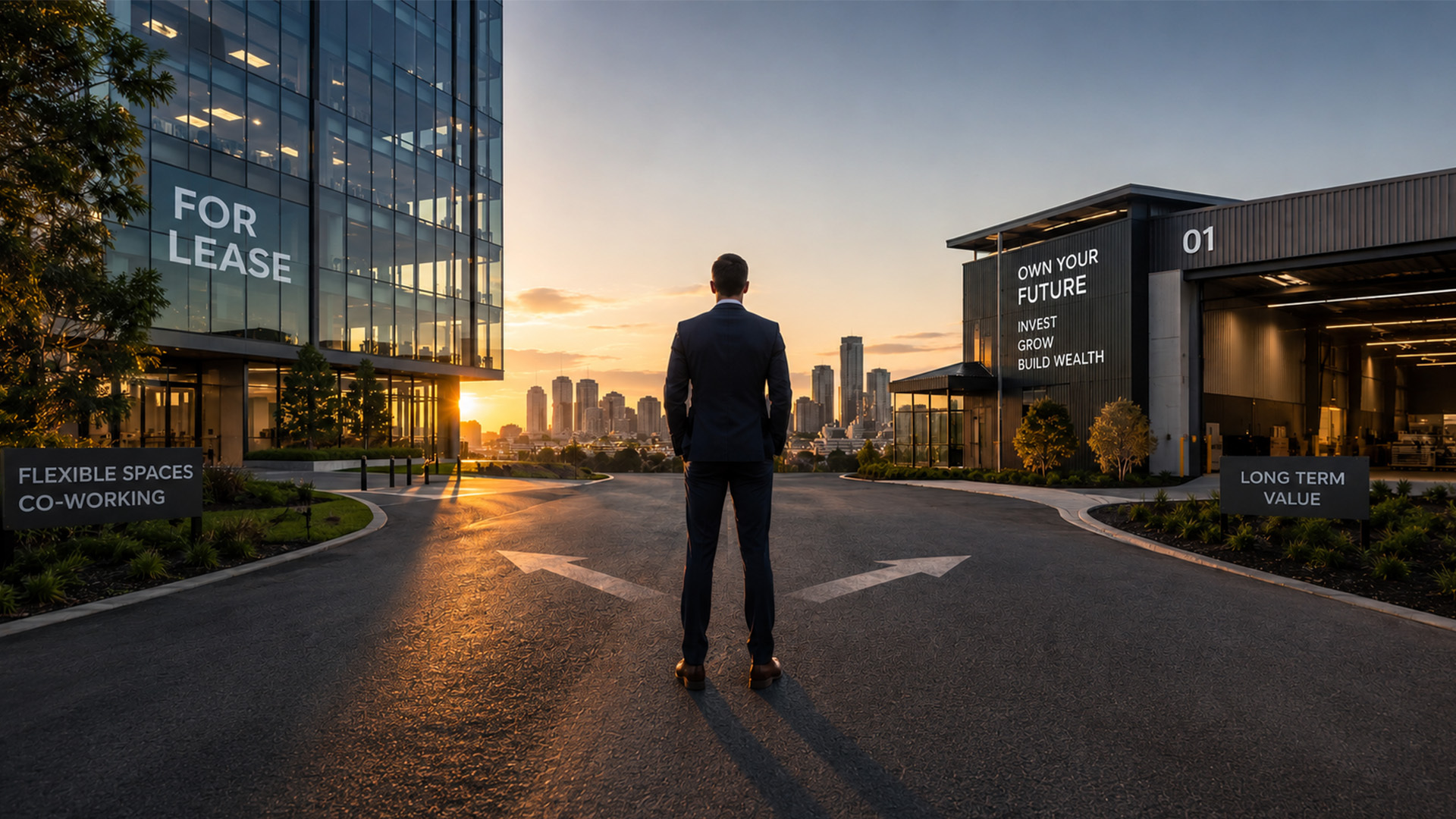
It’s one of the most common questions facing small and medium business owners across Gold Coast Queensland and northern New South Wales: should you buy your commercial or industrial space, or keep leasing and preserve capital flexibility?
There’s no universal answer. But for a growing number of trade businesses, boutique logistics operators, and SMEs across the SEQ corridor, buying particularly when entering early in a commercial development cycle is increasingly looking like the smarter long-term play. Here’s a balanced breakdown of both options, along with some important context from the commercial development side of the equation.
Leasing offers undeniable advantages, particularly for businesses in early stages or those that expect their space requirements to change significantly in the near term.
For businesses in high-growth or rapidly evolving sectors, leasing can be the pragmatic choice at least in the short term.
For established businesses with stable space requirements, buying commercial property particularly purpose-built industrial or commercial space offers a set of financial and operational advantages that are difficult to replicate through leasing.
Every mortgage repayment on a commercial property builds equity in an asset that you own. In contrast, every lease payment is a sunk cost money that leaves the business and generates no residual value. Over a ten or fifteen year period, the difference in wealth creation between an owner-occupier and a long-term tenant can be substantial.
In the current SEQ market, where industrial property values have risen consistently alongside strong rental demand, owner-occupiers have benefited from both business continuity and capital appreciation. The compounding effect of these two factors is powerful.
The Australian tax system offers meaningful advantages to business owners who purchase commercial property, particularly when the purchase is structured appropriately through a self-managed super fund (SMSF) or business entity.
Key considerations include depreciation claims on the building structure and fit-out, potential GST implications on purchase (and how they’re managed), interest deductibility on commercial loans, and capital gains tax concessions available to small business owners on disposal of commercial property. Each business’s situation differs, so independent financial and tax advice is important but the structural advantages of ownership are real and worth understanding before dismissing the option.
One of the most underappreciated risks in commercial leasing is what happens at the end of a lease term. Landlords can choose not to renew. They can increase rents substantially. They can redevelop or repurpose a site. For a business that has invested significantly in a fit-out, built a customer base around a location, or relies on specific infrastructure (three-phase power, overhead cranes, specific clearance heights), losing a lease can be operationally catastrophic.
Owner-occupiers face none of this uncertainty. The space is yours. You make the decisions. You can invest in the fit-out with confidence because you’re not building on someone else’s asset.
Here’s where the calculus becomes particularly interesting for QLD and NSW business owners. Purchasing space during the commercial development phase before construction is complete typically offers a more competitive entry price than buying finished stock on the open market.
Commercial building developers price pre-construction purchases based on current costs and reasonable margin. Once the development is complete, the finished product typically commands a premium that reflects market demand, reduced risk for buyers, and the developer’s need to realise value. Buyers who commit early effectively lock in today’s pricing while benefiting from any appreciation that occurs over the construction period.
In active markets like the Gold Coast industrial corridor, Coomera, and Tweed Heads South, this dynamic has played out consistently. Early buyers have seen meaningful equity growth between their purchase commitment and settlement before their business has even moved in.
Purchasing early in a commercial development phase also gives buyers the opportunity to work with developers on configuration and fit-out requirements. For trade businesses with specific needs drive-through bays, mezzanine offices, specific power requirements, container-height roller doors this collaboration can result in a space that’s genuinely optimised for operations.
A purpose-built space bought early is almost always a better operational fit than a second-hand building that needs retrofitting, and it typically commands stronger resale and rental values down the track.
The decision comes down to a few key variables: your capital position, your growth stage, your space requirements, and your long-term business goals. As a starting framework:
For many SMEs across QLD and northern NSW, the honest answer is that they’ve been leasing by default rather than by deliberate choice and when they run the numbers, buying stacks up better than they expected.
If you’re at that stage, it’s worth having a conversation with a commercial building developer who can walk you through what’s available, what stage of the development pipeline they’re in, and what the numbers look like in today’s market.

Interested in one of SunnyDev's properties? This is the right place.
Simply complete the form below and one of our team will be in touch to assist you with your enquiry.